
The Large Hadron Collider's planned downtime for the entire year of 2012 has been postponed. The LHC once again is on track to be the Doomsday machine of 2012. They're so happy with its performance so far, they don't want to shut it down so soon to upgrade it.
This means current plans have it operational on December 21st, 2012. Doomsday. Will the LHC be the cause? Only time will tell...
« Showing posts with label Large Hadron Collider. Show all posts »
Thursday, February 3, 2011
«Doomsday is Back on Track»

Tuesday, March 30, 2010
«Physics of the LHC»
The first 7 TeV collisions are now taking place in the Large Hadron Collider (LHC), breaking yet another record. They had achieved the 7 TeV energies earlier, but only now are they allowing the particle beams to cross and collide.
7 TeV is only half what the LHC was designed for. However, the LHC is basically its own prototype. It has been decided that the copper fail-safes between the superconducting magnets need to be redesigned before the LHC can reach the full 14 TeV power. The LHC will need to be shut down to perform these upgrades. For now they will run at half power until late 2011, at which time they will shut it down and upgrade it. It won't be scheduled to resume operation until 2013... So much for it being the 2012 doomsday device.
The LHC is 27km in circumference, and those hadrons (protons) in the beams are going around the ring 11,245.5 times a second. That's 99.999997828 percent the speed of light. There are 2 beams traveling in opposite directions.
Yet for all the power and speed of the LHC, nature bombards our atmosphere with far more energetic cosmic rays. Take the Oh-My-God particle for example. It slammed into the atmosphere over Utah with an energy of 3x10^20 electronvolts (equivalent to 300,000,000 TeV). That's why I'm not worried about black holes or anything else from the LHC eating Earth; if it were possible, nature would have already done it.Special Relativity1
Some strange Special Relativity takes place between the beams. Despite moving at near light speeds in opposite directions, they're still not moving faster than the speed of light relative to each other.
The entire 27km circumference of the collider is only a little over a meter in length relative to a beam; this is known as length contraction. Yet from one beam's perspective, the other beam has to travel 202,500km to get around that same circumference once. (Funfact: a 703.5 TeV cosmic ray "sees" the entire Earth as 17 meters thick.)
There's also a strange time dilation that would cause a beam to "see" a clock at rest as running 7,500 times slower. Yet if an observer at rest were to see a clock traveling with the beam, it too, would appear to be running 7,500 times too slow. So from both perspectives, it would appear as though the other clock is the slow one. This effect is increased to 112,000,000 (that's millions) times if the two beams were to look at each other's clocks. (Funfact: a 703.5 TeV cosmic ray would have "seen" only 6,000 years2 pass in the 4.5 billion years the Earth has been here.)
Seriously... Science is stranger than fiction. Yet Special Relativity is tame compared to Quantum Mechanics. When the beams collide, the resulting debris particles are where the Quantum Mechanics aspect of the LHC begin... Then you've got stuff that exists in opposite states simultaneously (quantum states), can jump across an impenetrable barrier (quantum tunneling), and fundamental particles yet unknown to physics (the elusive Higgs boson).
1: These calculations were made for the full 14 TeV output of the LHC (7 TeV in each direction). However, because the energy required to accelerate something near the speed of light increases exponentially, the figures are not far off from the current half-power speeds.
2: If the young-earth proponents were riding a cosmic ray, they might have been right!
Wednesday, September 10, 2008
«Fire Up the Doomsday Device, it's Show-Time!»
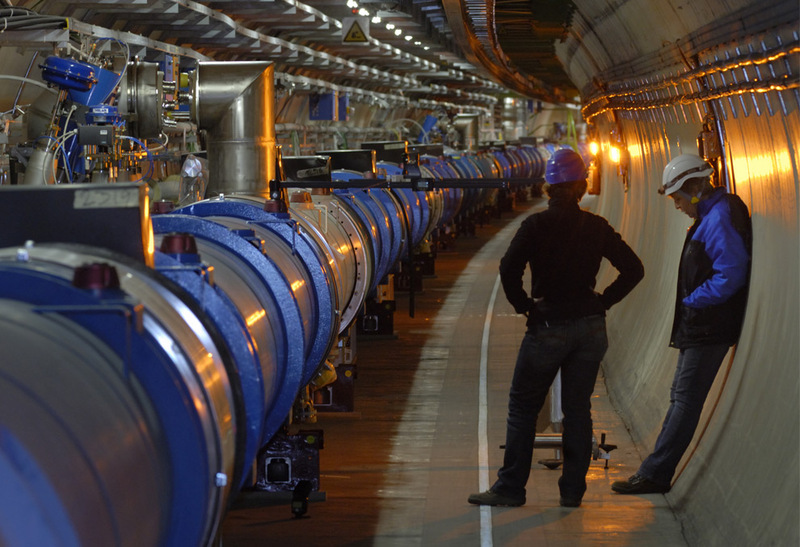 Today they will start to circulate the first particles through the Large Hadron Collider. However, the first collisions aren't scheduled until October 21st.
You might be wondering, what is a hadron anyway? A hadron is either a proton or a neutron; you know, the stuff atoms are made of. Its name could be taken the wrong way. It's not colliding over-sized hadrons, it's the collider itself that is large. It's the largest particle accelerator built to date, at 17 miles in circumference. It will accelerate those hadrons to near light speeds, traveling around that 17 mile circumference about 11,000 times a second. Then smash them into each other and see what the resulting debris is.
Why do this? Because the high energy levels involved might give some insight into what the first milliseconds of the universe were like. Hopefully, it will give some clues as to how and why properties like mass and gravity came to be. After-all, hadrons have a mass 100 times greater than the quarks that they are comprised of for reasons yet unknown. Truly, greater than the sum of their parts.
As I've said before, there's no chance of creating a black hole that will devour Earth. We've been bombarded with natural cosmic rays that have higher energy levels (moving at speeds even faster than those possible in the LHC). However, the natural occurrences are sparse and unpredictable, so they can't be properly observed with the right equipment. That's why we need the Large Hadron Collider.
EDIT: Oh, I just had to add this when I saw it. Take a look at Google's logo for today, it's the Large Hadron Collider:
Sunday, March 30, 2008
«Large Hadron Collider»
 Asking a Judge to Save the World, and Maybe a Whole Lot More
Like I said, the next thing on the list to kill us all is the Large Hadron Collider. Now there's a lawsuit against it in Hawaii, no less (the Large Hadron Collider is in Switzerland). They claim it could destroy Earth, and possibly the universe (?).
I've already explained in a previous blog post why the collider isn't a threat... Nature throws far more energized particles into our atmosphere and we haven't been consumed by a micro-black hole yet. And the universe? There are massive black holes in the center of galaxies, why would some micro-black hole threaten the universe?
Heh, I have a motivational poster about the Large Hadron Collider, but it's NSFW... The Large Hardon Collider.
Wednesday, January 30, 2008
«OMFG, We didn't all die!»
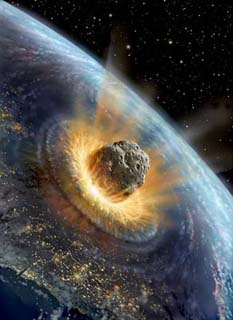 So it looks like we didn't all die from 2007 TU24, so I guess the Large Hadron Collider is once again, the next on the list. Notice, however, that the media didn't really cover the asteroid until after it passed?
I don't believe the Large Hadron Collider is a threat either. The deal with it is, there's a chance of creating micro black holes. Of course, that freaks a lot of people out. As the most supported theory goes, Hawking Radiation will cause a micro black hole to evaporate before it can interact with anything, thus avoiding the disaster of the mini black hole consuming Earth. One reason I'm inclined to believe it poses no threat is because we've been bombarded by far more energetic particles from nature, that had a greater chance of creating a micro black hole on Earth. In other words, nature's already did it and we survived just fine.
I remember seeing a list of 20 ways the world could end suddenly, and particle accelerator mishap was on the list. So was asteroid impact and rouge black hole. Ah, here's the list:
Twenty Ways the World Could End Suddenly
Subscribe to:
Posts (via reader)


 Some Rights Reserved